In today’s competitive digital landscape, driving traffic is only half the battle. The real challenge lies in converting visitors into leads and customers. This is where optimizing your marketing funnels and landing pages becomes crucial.
A well-structured funnel guides users from awareness to action, while a high-performing landing page ensures they don’t drop off before converting. In this article, we’ll explore proven strategies to optimize marketing funnels and landing pages for better engagement, lower bounce rates, and higher conversions.
What is a Marketing Funnel?
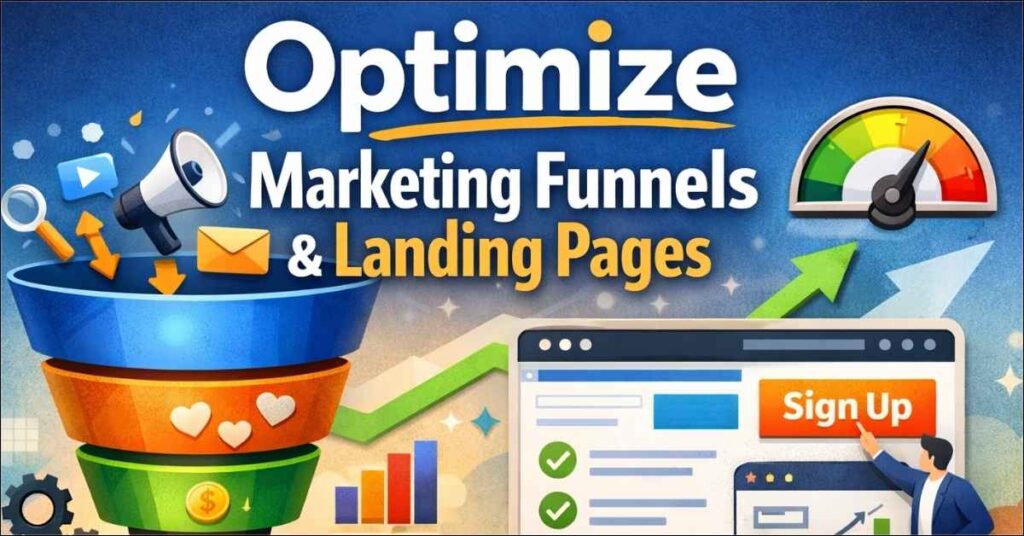
A marketing funnel represents the customer journey from first interaction to final conversion. It typically consists of:
- Awareness – Users discover your brand
- Interest – They explore your product or service
- Decision – They compare options
- Action – They convert into customers
Optimizing each stage of the funnel ensures that potential customers move smoothly toward conversion without friction.
Why Landing Page Optimization Matters
Landing pages are designed for a single purpose: conversion. Whether it’s signing up for a newsletter, downloading an eBook, or requesting a demo, a poorly optimized landing page can significantly reduce your campaign performance.
Key benefits of landing page optimization include:
- Higher conversion rates
- Improved user experience
- Better Quality Score for paid ads
- Reduced cost per lead
Best Practices to Optimize Marketing Funnels and Landing Pages
1. Define Clear Goals for Each Funnel Stage
Each stage of your funnel should have a specific objective:
- Awareness: Educate and inform
- Consideration: Build trust
- Conversion: Encourage action
Align your landing page content with the user’s intent at that stage.
2. Craft Compelling Headlines and CTAs
Your headline should clearly state the value proposition. Pair it with strong Call-to-Action (CTA) buttons such as:
- “Get Your Free Quote”
- “Download the Guide”
- “Start Your Free Trial”
Make CTAs visually distinct and action-oriented.
3. Simplify Forms and Page Layout
Long forms reduce conversions. Ask only for essential information.
Keep your layout clean with:
- Short paragraphs
- Bullet points
- Ample white space
This improves readability and keeps users focused.
4. Use Social Proof and Trust Signals
Boost credibility by adding:
- Customer testimonials
- Case studies
- Star ratings
- Security badges
These reassure visitors and reduce hesitation.
5. Optimize for Mobile and Page Speed
More than half of web traffic comes from mobile devices. Ensure your landing pages:
- Load in under 3 seconds
- Are responsive across devices
- Have large, clickable buttons
Google also prioritizes fast, mobile-friendly pages for SEO.
6. Run A/B Tests Regularly
Test different versions of:
- Headlines
- CTA colors
- Images
- Form length
Data-driven testing helps identify what converts best and removes guesswork.
Tools to Improve Funnel and Landing Page Performance
Before optimizing landing pages, businesses must focus on attracting the right audience. Our detailed article on organic website traffic growth strategies explains how to bring in qualified visitors who are more likely to convert.
Some useful tools include:
- Google Analytics & GA4
- Google Tag Manager
- Hotjar / Microsoft Clarity
- HubSpot / Zoho CRM
- Elementor / WordPress page builders
These tools provide insights into user behavior and help fine-tune performance.
Common Mistakes to Avoid
- Sending all traffic to one generic page
- Ignoring mobile optimization
- Weak or confusing CTAs
- No follow-up email automation
- Not tracking conversions
Avoiding these mistakes can dramatically improve ROI.
Conclusion
Optimizing marketing funnels and landing pages is not a one-time task but an ongoing process. By understanding user behavior, refining content, improving design, and testing regularly, businesses can significantly boost conversions and reduce customer acquisition costs.
A well-optimized funnel combined with a high-converting landing page turns visitors into loyal customers and ensures your digital marketing efforts deliver real results.